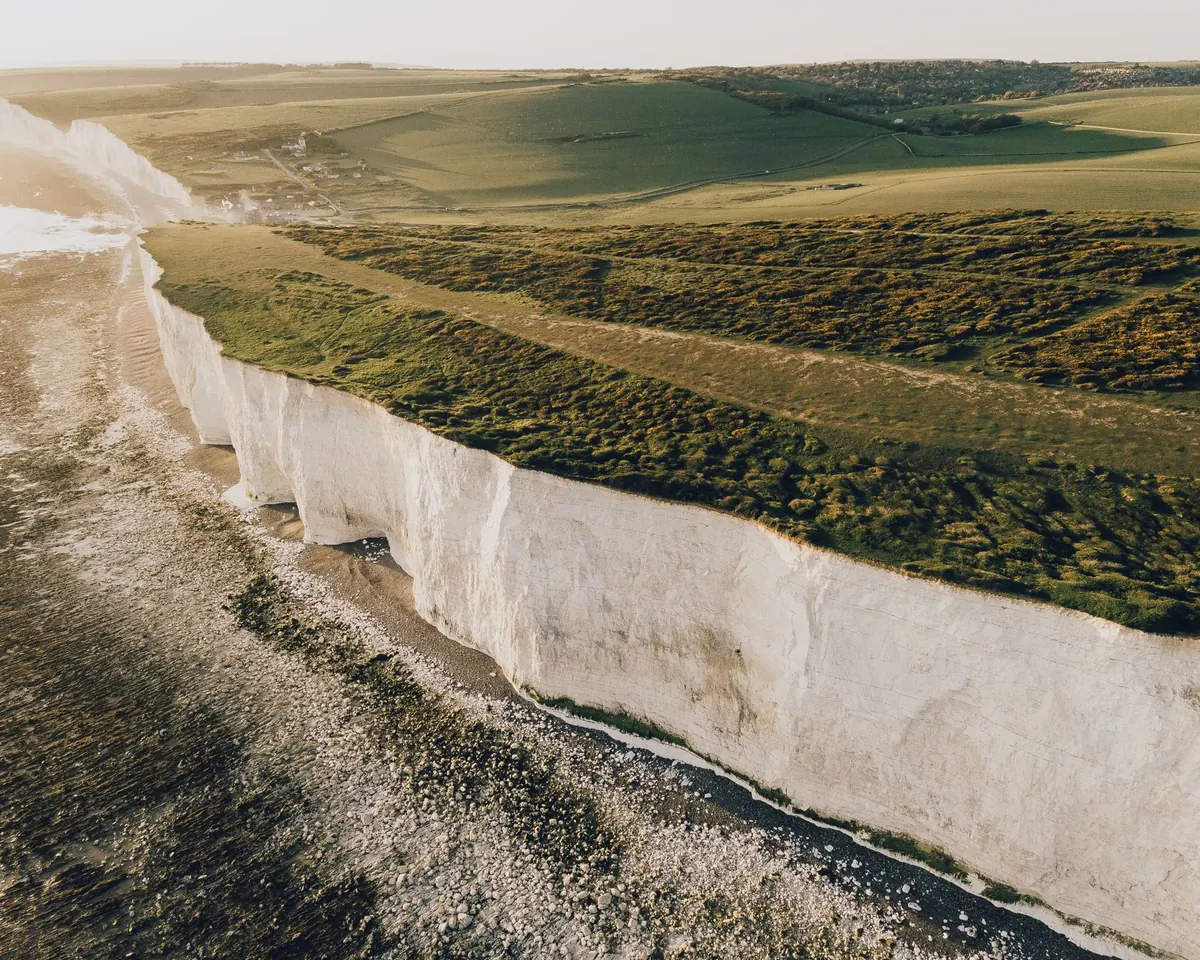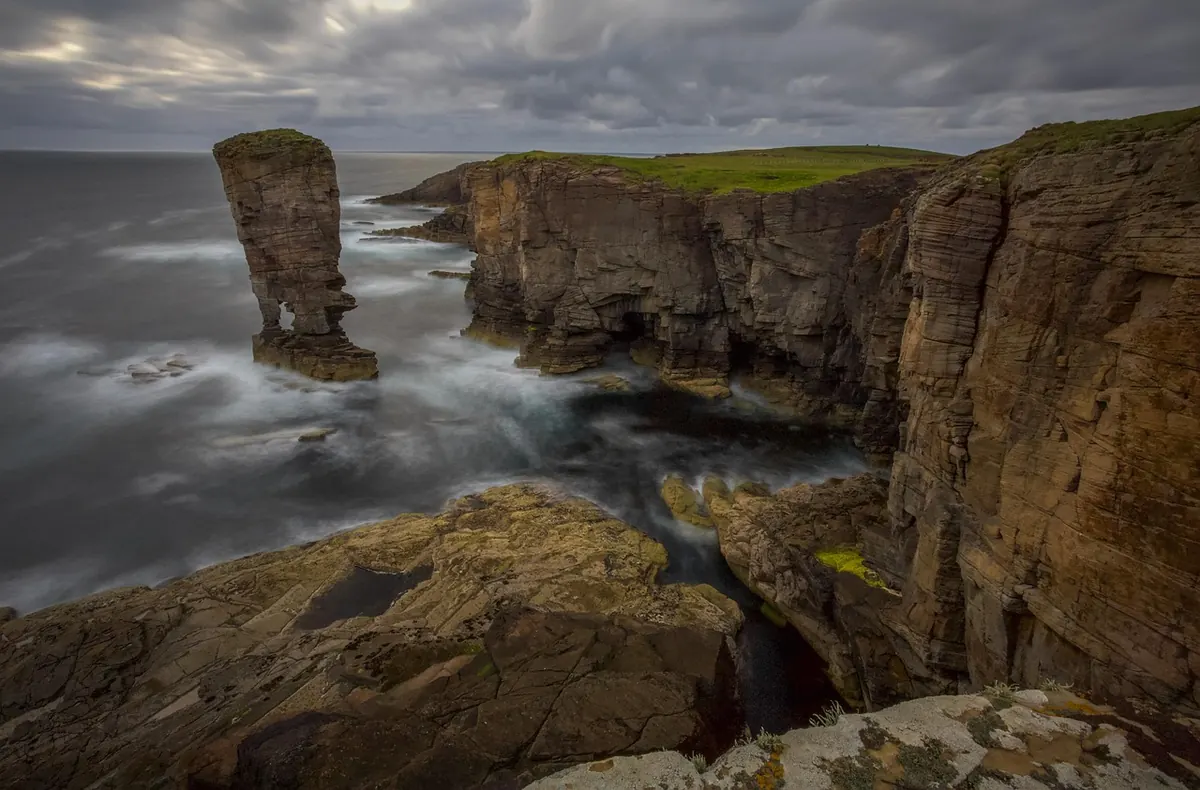
A sea stack is not a permanent monument so much as a moment caught mid-process. The chalk column standing off the headland was part of the cliff not long ago, and it is well on its way to becoming a low stump that only shows at low water. The sequence is simple — cave, arch, stack, stump — and once you know it, you can read almost any exposed stretch of British coast and work out roughly where it sits in that story. The whole process is driven by the sea, but it is controlled by the rock: its weaknesses, its layers and the way it meets the waves.
Not every cliff produces stacks. Three things have to line up. The rock needs weaknesses — vertical joints, faults or bedding planes that let water in. The waves need to reach the base of the cliff for at least part of every tide, so a tall cliff above a low tidal range won't erode at sea level at all. And the coast needs headlands that stick out into the full force of the swell, because waves refract and concentrate their energy on promontories rather than on sheltered bays.
Where those conditions meet, the process is patient and mechanical. At high tide, water and trapped air are forced into a joint under pressure; sand and pebbles grind away at the opening. The crack widens, deepens and becomes a cave. Caves tend to follow the line of least resistance, often running inland parallel to the coast, and a long narrow one is known as a geo. If the roof above a cave is thin, spray, pebbles and compressed air can punch a hole right through to the cliff top, leaving a blowhole that spouts water in a heavy sea.
Geologists group these processes under names worth knowing: hydraulic action, where trapped air is compressed and explosively released; abrasion, where sediment is used like sandpaper; and solution, where slightly acidic seawater slowly dissolves certain rocks. Together they turn a hairline weakness into a cave, and a cave into the first stage of a future stack.
Now give a narrow headland a cave on each side. Both eat inwards along the same weakness until they meet, and suddenly there is daylight through the promontory. This is the arch stage, and it is the most photogenic — and the most precarious. A span is wide, the roof is comparatively thin, and every storm removes a little more support from the piers.
Durdle Door in Dorset is the classic British example: a band of harder Portland limestone that resisted the sea longer than the softer rock around it, leaving a clean doorway in the cliff. The Green Bridge of Wales in Pembrokeshire shows the same principle in Carboniferous limestone, with a broader, flatter roof. Further north, Bow Fiddle Rock at Portknockie in Moray takes its name from the curve of hard quartzite that survived while its neighbours were removed.
Arches rarely last long in geological terms. Treat any span you see as a temporary arrangement, and never be tempted to walk across one or linger directly beneath it. The sea is still working on the joints, and a roof that looks solid can be thinner than it appears.
Eventually the roof fails. A storm, a heavy swell or simply the accumulated removal of support drops the span into the sea, and the seaward pier is left standing alone. What makes it a stack rather than a lump of headland is the gap: the tide must be able to flood between the column and the cliff. Where the landward side survives, you often get a buttress attached to the cliff, with the stack separated by a channel of tide-washed rock.
Marsden Rock at South Shields is a good reminder of how quickly this can happen. A large section of it came down in the 1990s, changing the shape of a landmark that had looked settled for generations.
An arch is not always required. A headland can also be attacked from two sides at once, narrowing until the sea cuts through the neck and leaves a detached column. Old Harry Rocks at Handfast Point in Dorset is the finest British illustration of the later stages: a run of chalk stacks and stumps that are the last remnants of a ridge which once linked the Isle of Purbeck to the Isle of Wight. The Needles, at the western tip of the Isle of Wight itself, are three chalk stacks in the same tradition.
Undercutting does not stop once a stack is isolated. Waves keep cutting a notch at the base, and the column loses height from the top through falls as well. The result is a stump: low enough to be awash at high tide, a reef at low water, often draped in weed and colonised by limpets, mussels and roosting birds. At Handfast Point, the stack known as Old Harry's Wife has already collapsed, leaving a stump that shows at low water. Even in this reduced form, a stump still takes energy out of the waves before they reach the cliff behind, so it continues to shape the coast even as it disappears.
Stumps can be easy to miss. At high tide they may look like little more than white water or a dark patch of rock. At low water they reveal their true form: a broad, wave-smoothed platform with a few resistant blocks still standing proud. That platform is a sign that a stack once stood there, and that the coastline has moved one more step towards the shape we see today.
The speed of the life cycle depends almost entirely on the rock and the sea. Soft glacial till, like the cliffs of Norfolk and Holderness, can retreat by metres in a single winter, but it rarely forms durable stacks because it crumbles too quickly. Harder chalk, limestone and quartzite are more stubborn. They can hold a headland for thousands of years, then lose an arch in a single storm.
A stack may stand for centuries, or it may collapse within a human lifetime. Old Harry's Wife came down in 1896, while some of the Needles have survived long enough to be mapped, painted and photographed for generations. There is no fixed timetable. The coast is not following a script so much as testing every weakness, tide by tide, until the rock gives way.
Once you know the sequence, a walk along an exposed coast becomes a lesson in process. Look for the clues in order, and remember that the sea is still at work.
Safety matters more than a photograph. Check tide times, keep away from cliff edges and the base of loose cliffs, and never assume a rock arch or stack is stable. The same processes that created it are still trying to remove it.
Sea stacks are more than geological curiosities. They are landmarks that help us measure coastal change, and they are often havens for wildlife. Guillemots, razorbills, kittiwakes and cormorants nest on ledges that land predators cannot reach. Seals haul out on nearby skerries. Below the waterline, the rock is colonised by algae, barnacles and mussels, creating a small but rich habitat in an otherwise mobile sea.
They also remind us that the coast is not a fixed line on a map. It is a dynamic edge, built and rebuilt by waves. The stack you see today was a headland, then an arch, and will one day be a stump. Understanding that life cycle does not spoil the view; it deepens it. The next time you stand on a cliff and see a column of rock offshore, you are looking at a single frame in a very long film — and the sea is already working on the next scene.
Photo: dmccreight / Pixabay