Stand on almost any sandy beach in Britain with a steady onshore wind behind you and you can watch the first stage of a dune system being built. Grains skip along the beach, meet the first clump of sand couch or marram, and stop. Repeat that a few billion times and you have a ridge. Repeat it across a few centuries and you have the whole run of hummocks, damp hollows and grassy hills that sits behind the strandline. Dune systems are not scenery. They are weather, slowed down and given a shape — and they are still moving.
Wind-blown sand is picky. It travels only when the grains are dry, exposed at the surface, and the wind just above that surface is strong enough to lift them. Take away any one of those three and the dune stops growing.
Two things follow from that. Wet sand does not move, which is why a rainy week or a high winter water table calms a mobile dune. And anything that slows the wind in the last few centimetres above the ground — a pebble, a piece of driftwood, one plant — makes sand drop out of the airflow. That is the whole trick behind dune formation.
The first colonists on a British beach are usually sand couch, sea rocket and orache — low, wiry plants that tolerate salt spray and occasional burial. Sand couch is the important one. As sand piles around it, the plant grows up through the new surface, which keeps it alive while also roughening the ground and slowing the wind. Sand drops, the mound grows, the plant grows again. These small mounds, often barely knee-high, are embryo dunes.
Behind them comes marram grass, the workhorse of the British dune system. Marram is built for burial: it pushes up through fresh sand and actually grows more vigorously when it is being buried. Where sand stops arriving, marram weakens and eventually gives way to other species. That is a useful clue when you are reading a dune — healthy marram means an active, accreting dune.
Embryo dunes are fragile. One winter storm can flatten them, and a single well-worn footpath can kill the vegetation holding them together. They only survive where the beach is wide enough to have a dry backshore and the sand supply is steady.
Walk inland from the top of the beach and you are walking through time. Each zone is older, more sheltered, more vegetated and less mobile than the one in front of it.
There is a quiet chemical change running alongside that sequence. Young dunes are alkaline, because the sand contains shell fragments. As rain leaches the lime out over decades, the older dunes turn acidic, and the plant community changes with them.
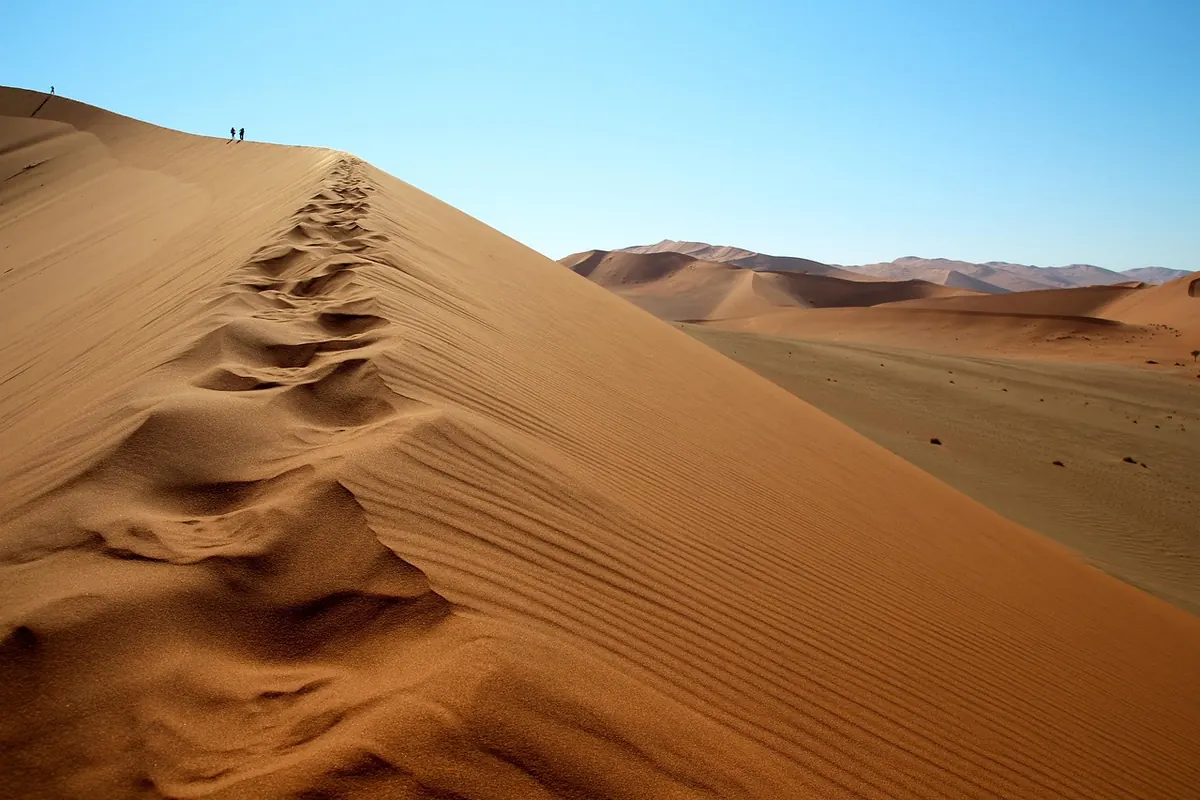
A dune ridge is lopsided. The seaward face is gentle, often only a few degrees. The landward face is steep — close to the angle at which dry sand will no longer hold itself up, roughly 33 degrees.
Wind strips sand from the gentle windward slope, carries it over the crest and dumps it on the steep lee slope, where it slides down in small avalanches. The crest edges inland. Do that for long enough and the whole ridge moves.
Sand moves when it is dry, exposed and windy. Remove any one of those three and the dune stops dead.
Because new dunes keep forming at the beach and old ones keep being overrun at the back, the entire system rolls inland like a slow wave. How fast depends on sand supply, beach width, the local wind climate, how healthy the vegetation is, and how much disturbance it has to absorb. In some places a ridge shifts a few centimetres a year; in others it can move metres. Both are normal.
A blowout starts when vegetation breaks — a footpath, a fire, rabbit burrowing, storm erosion — and the wind gets a bite into bare sand. Once a hollow forms it tends to deepen, because the sides funnel wind through it. Given time, a blowout can stretch inland as a parabolic dune, a U-shaped feature with two long trailing arms pointing back towards the beach.
Dune slacks are the opposite. These are hollows deep enough to reach the water table, wet in winter and often dry in late summer, and they hold some of the rarest plants in the country. If you are on a reserve, slacks are usually the reason for the fencing.
Dunes do real work. They act as a reservoir of sand that feeds the beach during storms, and as a natural sea defence. But a dune can only roll inland if there is somewhere for it to roll into. When a sea wall, a road, a golf course or a caravan park sits directly behind the back dunes, the system is pinned. Sand is lost from the front during storms and cannot be replaced from behind. The dune narrows, then steepens, then starts to fail. This is what coastal managers mean by coastal squeeze.
A few minutes of looking tells you a lot about which way a dune is heading.
Go after an onshore gale rather than on a flat calm day. Look along the strandline for new embryo mounds forming around debris, then come back after the winter and see which ones survived. Keep to boardwalks and marked paths across foredunes and embryo dunes: the vegetation is the only thing holding that sand in place, and twenty pairs of boots in the wrong place can start a blowout that takes decades to heal. Keep dogs close and away from nesting birds in spring and summer.
If you are planning planting, fencing or any other work on a dune, talk to the local council or the conservation body that manages the site first. Dune restoration is done by people who know the site, and small mistakes at the front of a dune system are expensive to undo.
Photo: Naturefreak / Pixabay