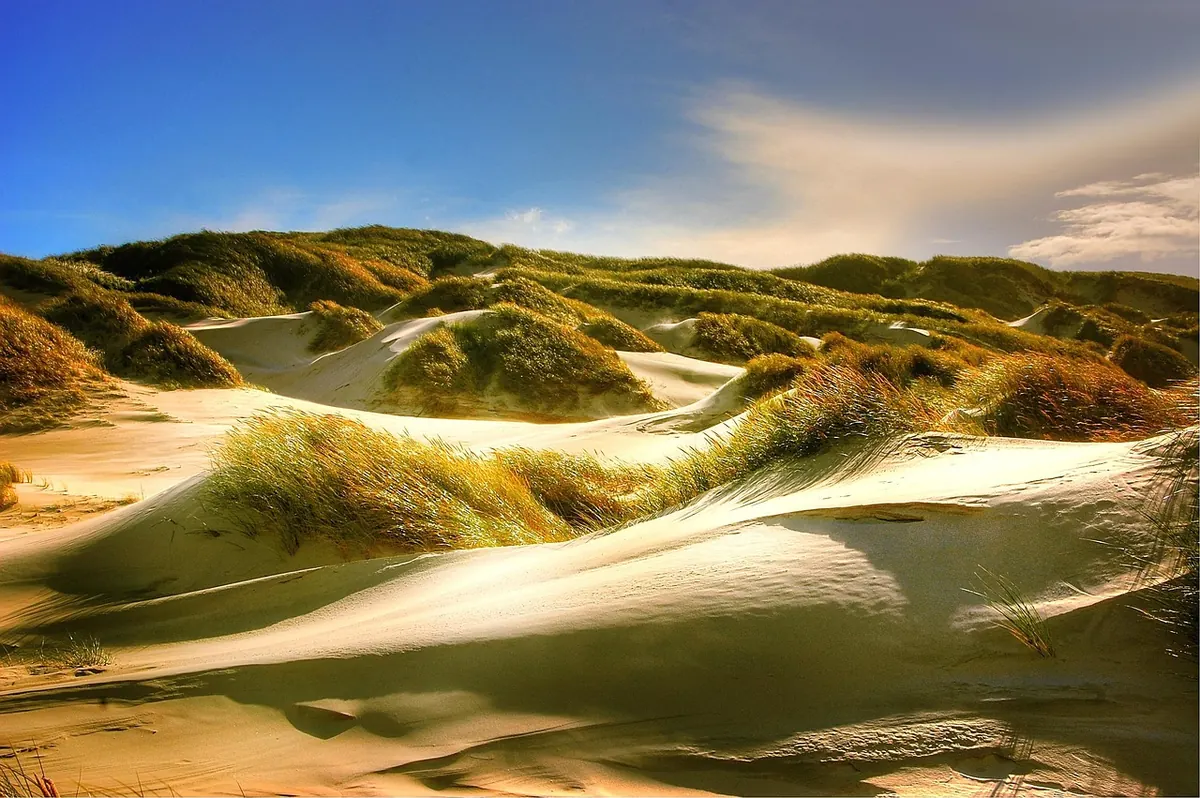
A dune is not one habitat but a stack of them, laid out in bands as you walk inland from the tideline. Get the band right and identification becomes far simpler: the plant you cannot name on bare sand is rarely the same species growing in a damp hollow fifty metres back. The six below are the ones you are most likely to meet on a British coast, from Cornwall to the Moray Firth, along with notes on where each belongs and how to look at them without wearing the dunes away.
Before you try to name anything, work out which zone you are standing in. The classic sequence, running inland, looks like this:
Most mistakes come from expecting a foredune plant in a dune slack, or the other way round. Take a few steps back, look at the sand under your feet, and the shortlist shrinks quickly.
Marram (Ammophila arenaria) is the species that makes the dunes you are standing on. It grows in stiff, upright tussocks of grey-green leaves that roll inwards at the edges, so each blade feels like a narrow tube rather than a flat strap. Run a thumb along one and you will meet a sharp point; flatten a leaf and it springs back. The flowering heads are pale, cylindrical and wheat-like, appearing in mid-summer.
Look for marram on the yellow dunes, where sand is still moving. It survives burial by growing upwards through fresh sand, and its long creeping rhizomes knit the dune together below the surface. When you see a dune ridge with a fringe of tussocks on top, that is almost always marram doing the structural work.
These two grow closer to the tide than marram, and they are easily confused until you know what to check.
Leymus arenarius is unmistakable once seen: broad, flat, blue-grey leaves with a soft, almost waxy bloom, and stout bristly flower spikes in summer that look like a small, coarse wheat. It sits on the upper beach and the very front of the foredune, often in loose colonies rather than tight tussocks. The leaves are pliable and fold easily, unlike marram's.
Elytrigia juncea looks scruffier. Its stems are wiry and sparse, its leaves narrow and rolled, and its flower spikes slender with bristle-like awns. It favours the same seaward edge as lyme grass but often forms thinner, patchier cover. If a grass on the upper beach looks half-starved and untidy, sand couch is a fair bet.
Sea holly (Eryngium maritimum) is the one plant on this list you will probably spot from twenty paces. The leaves are grey-blue with pale veins and spiny, holly-like edges; in high summer the stems and flower heads take on a metallic blue that stands out against pale sand. It grows on mobile dunes and shingle, sinking a deep root into the sand to reach moisture.
It flowers from roughly July into September. Because it is slow to establish and does not tolerate disturbance, it is a good indicator of a dune section that has not been walked over too heavily — a useful thing to notice when you are deciding where to put your feet.
Sea sandwort (Honckenya peploides) forms low, sprawling mats of fleshy, yellowish-green leaves on the strandline and the lowest part of the foredune. The leaves are thick and rounded, and small white five-petalled flowers appear in early summer. It looks like a plant that expects to be buried, and it is: it grows through fresh sand and helps hold the very first ridge together. Walk the tideline after a spring tide and you will often find it in exactly the strip where the debris stops.
Sea buckthorn (Hippophae rhamnoides) is a shrub, not a grass, and it changes the character of a dune system where it takes hold. The leaves are narrow and silvery, with a slightly metallic underside, and the stems carry long, sharp spines. It is dioecious, meaning male and female flowers sit on separate bushes, so only the female plants carry the dense clusters of orange berries in autumn.
It is native in parts of eastern and southern Britain and has been planted widely elsewhere for stabilisation, which is why some reserves now cut it back to stop it shading out dune flowers and slacks. Look for it in the older, fixed parts of the dune system and along scrubby inland edges. The berries are edible but sharply sour; on protected sites, leave them for the birds and check local signage before picking anything.
Dune vegetation is tougher than it looks in one sense and far more fragile in another. A single footprint in a dune slack can persist for a season; a new desire path across a foredune can start sand blowing and undo years of stabilisation. A few habits make a real difference:
None of this stops you getting close. It just means choosing the right route in, standing still for a moment, and letting the zones tell you what you are looking at.
Photo: kordi_vahle / Pixabay