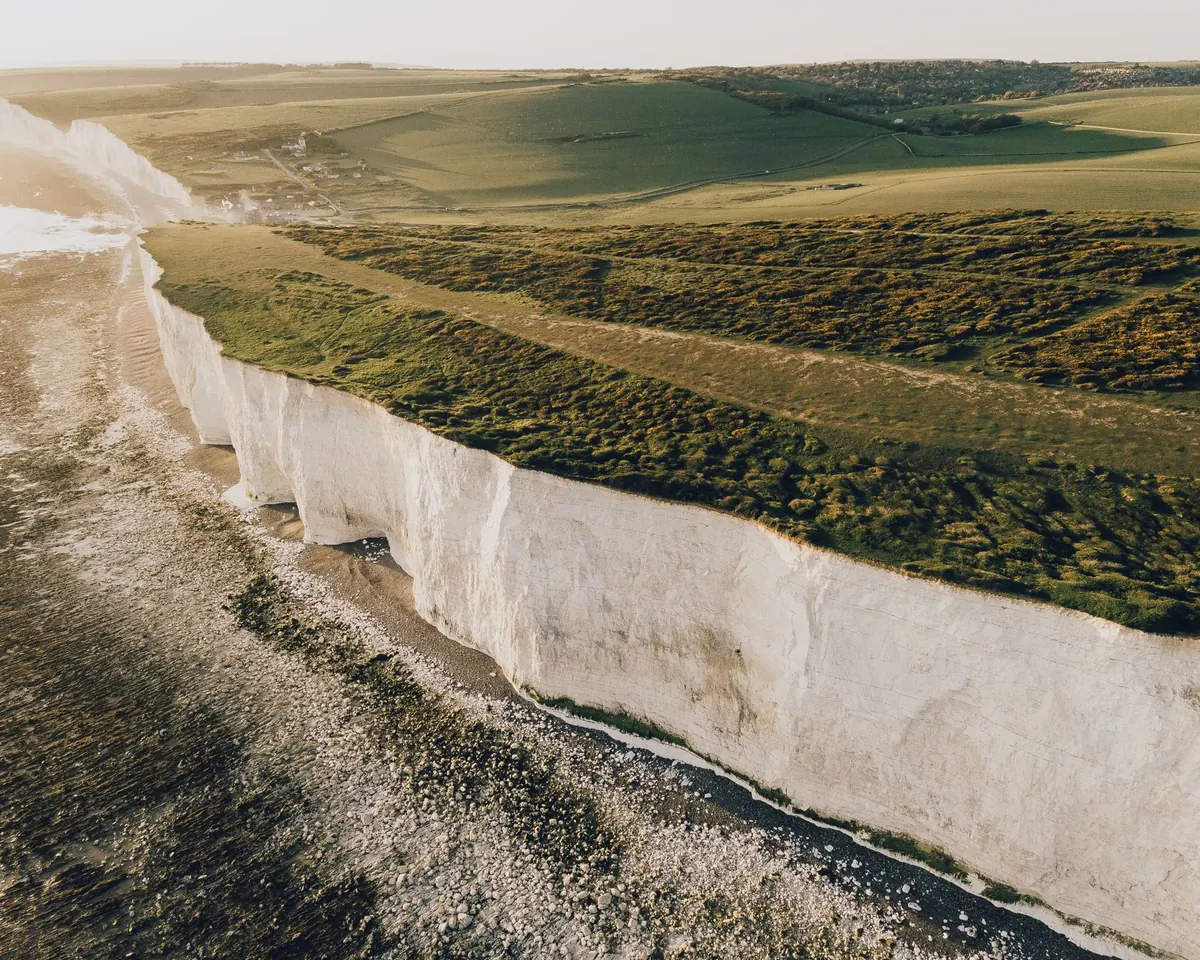
Stand at the foot of the Seven Sisters and you are looking at white chalk quietly shedding blocks into the sea. Stand on the granite at Land's End and you are looking at rock that has barely shifted since the last ice age.
Both are British cliffs, and they behave in completely different ways. Chalk, granite and sandstone account for most of our coastline, and the rock underneath decides almost everything else: how steep the cliff stands, how fast it retreats, what nests on it, and what the beach below looks like.
Two things govern how a cliff behaves: how the rock is put together, and how it fails. Rock is far stronger in bulk than along its flaws. Granite with widely spaced joints leaves in blocks. Chalk, riddled with close-set bedding planes, comes away in slabs. Sandstone sits between the two and swings enormously depending on what cements the grains together; silica makes a stubborn cliff, iron oxide or carbonate makes one that crumbles.
Know the material and the profile, the erosion rate, the birdlife and the beach all fall into place.
Chalk is a limestone built from the plates of microscopic algae, laid down in warm Cretaceous seas. It is soft enough to scratch with a knife, porous enough to hold water, and famously white.
Near-vertical faces, often with bands and nodules of flint picked out in dark lines. At the base, a wave-cut notch; at the top, a rounded grassy shoulder where the edge has slumped back. Dover, the Seven Sisters, Flamborough Head and Old Harry Rocks are the same rock in different moods.
Chalk is brittle rather than weak. The sea undercuts the base, water and frost widen the joints, and blocks drop: sometimes a few pebbles, occasionally a whole section. Retreat happens on a human timescale, so chalk coasts are where you can genuinely see change within your own lifetime.
Chalk gives Britain some of its finest seabird cliffs. Flamborough and Bempton hold gannets, guillemots, razorbills, puffins, kittiwakes and fulmars. On top, thin chalk grassland carries orchids, cowslips and rock-rose, with peregrines hunting along the edge.
Chalk makes poor sand, and much of the fine material is carried offshore. What remains is flint shingle, chalk cobbles and boulders, with a broad rock platform exposed at low tide.
Granite is igneous rock: magma that cooled slowly underground, producing coarse interlocking crystals of quartz, feldspar and mica, exposed only after millions of years of uplift and erosion. Much of Cornwall is granite, along with Pembrokeshire, Anglesey, the Scottish west coast and St Kilda.
Irregular and blocky. Joints are widely spaced, so the rock parts into great rectangular blocks. The coast is full of zawns, deep narrow inlets, and geos, tight clefts cut along fractures. Cliff tops carry tors, and some stretches have raised beaches sitting above the present shoreline.
Slowly, and mostly along the joints. Waves prise out blocks, but with so few fractures to exploit there is little to work on. In one lifetime a granite cliff looks unchanged.
Life here is about lichens, heath and hardy flowers such as thrift, sea campion and spring squill, with gorse and heather above. Choughs nest in crevices in west Wales and Cornwall, ravens and peregrines patrol the edges, and grey seals haul out in sheltered coves. Scottish granite islands hold large seabird colonies.
Coarse, gritty, often pale sand, sometimes made largely of shell fragments, plus boulder beaches with storm ridges of rounded blocks. Granite produces little fine sediment, so long dune-backed strands are rare.
Sandstone is sedimentary: sand grains cemented together, and the cement is what matters. Silica-cemented sandstone can be nearly as tough as granite; sandstone held together by iron oxide or calcium carbonate crumbles in your hand. British examples include the red Triassic cliffs of East Devon at Sidmouth and Exmouth, the Hastings Beds at Hastings and Fairlight, and the Old Red Sandstone of Wales and Scotland.
Grainy, bedded and often striped, with cross-bedding visible where ancient dunes and river channels were preserved. These coasts are cavey: sea caves, alcoves and blowholes form readily, and salt crystallising in the pores produces honeycomb weathering. Cliff tops are often crumpled into vegetated slumps.
The variable one. Hard sandstone behaves like tough rock and retreats slowly. Soft sandstone does not: groundwater seeps along bedding planes, frost opens cracks, salt spray prises at the surface, and whole sections slip. On the fastest stretches the cliff edge moves noticeably within decades.
Soft cliffs are less about seabirds and more about insects and plants. Bare sand and clay faces are prime nesting ground for solitary bees and wasps, sand martins tunnel into softer layers, and slumps are colonised quickly by coltsfoot, sea beet and gorse.
Sandstone makes sand, and the beach takes its colour from the rock: the red cliffs of East Devon feed red sand. Expect wide, gently sloping bays, sometimes with dunes behind them.
Keep this in mind when you are planning a walk:
You do not need a geology degree to tell these apart. On your next cliff-backed beach:
Do it from a safe distance. Keep away from the base of any cliff, and well back from the edge on top; falls happen without warning, most often after heavy rain or a hard frost. Check tide times before rounding a headland, and stay clear of nesting ledges between spring and midsummer, when disturbance is an offence and many of these sites are protected. Learn to read one of each and the whole coastline starts making sense.
Photo: JACK REDGATE / Pexels